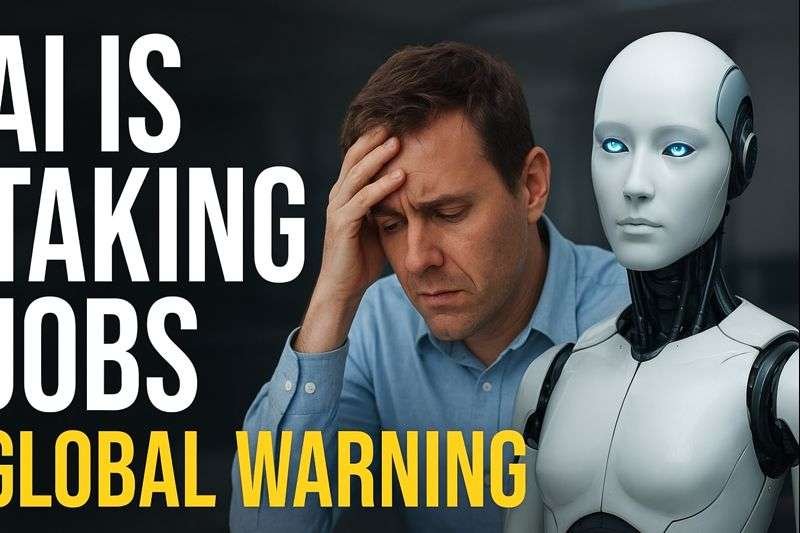
Artificial Intelligence is replacing jobs worldwide at record speed. Experts warn of mass disruption, new skills, and urgent reskilling needs. Read the full global report.
AI (Artificial Intelligence) is no longer a promise of the future—it has become a powerful force reshaping everyday life. From offices and factories to hospitals and newsrooms, ITS is quietly changing how work gets done. What once sounded like science fiction is now a daily reality for millions of workers around the world.
But with this rapid transformation comes an uncomfortable question: Is AI replacing jobs faster than society can adapt?
Governments, economists, and technology leaders are increasingly sounding the alarm. The concern is no longer if jobs will change—but how many will disappear, how fast, and who will be left behind.
AI’s Explosive Growth Across Industries
Over the past two years, A I tools have advanced at breakneck speed. Technologies such as generative A I, automated customer support systems, and machine-learning platforms are now being adopted by companies of all sizes.
Businesses are turning to A I because it offers:
-
Lower operational costs
-
Faster decision-making
-
24/7 productivity without fatigue
As a result, AI has already made deep inroads into several major industries:
-
Technology and Software
-
Media and Journalism
-
Customer Service and Call Centers
-
Banking and Financial Services
-
Healthcare Diagnostics

-
Manufacturing and Logistics
-
Marketing and Advertising
According to global labor studies, millions of jobs could be automated or dramatically altered within the next decade, making this one of the fastest workforce shifts in modern history.
“AI Is Taking Jobs” Most at Risk of Automation
Not all jobs face the same level of risk. Positions built around repetitive tasks, structured data, or predictable workflows are the most vulnerable.
Roles Under the Greatest Threat:
-
Data entry and clerical jobs
-
Call center and support agents
-
Junior software testing roles
-
Basic content writing positions
-
Accounting and bookkeeping jobs
-
Assembly-line manufacturing workers
AI systems can complete these tasks faster, cheaper, and often with fewer errors, making them an attractive option for companies trying to stay competitive.
Why White-Collar Workers Are Also Worried
For years, many believed automation would mainly affect blue-collar jobs. That belief no longer holds true.
Modern AI can already:
-
Write articles and business reports
-
Review legal contracts
-
Generate computer code
-
Design advertising campaigns
-
Assist doctors in diagnosing diseases
Several multinational companies have publicly acknowledged reducing hiring or restructuring teams after integrating AI systems. White-collar professionals—once considered safe—are now facing uncertainty.
A Growing Divide in the Global Job Market-AI
The AI revolution is creating a clear divide between workers who can adapt and those who cannot.
-
Employees with skills in A I, data science, and cybersecurity are seeing rising demand and higher wages
-
Workers without access to training face job insecurity and stagnant incomes
Developing countries are particularly vulnerable, as many outsourcing and service-sector jobs are among the first to be automated.
What Global Experts Are Warning
International organizations are increasingly vocal about the risks ahead.
The World Economic Forum (WEF) and International Labour Organization (ILO) have both warned that large-scale workforce disruption is unavoidable.
A recent WEF report stated:
“A I will create new jobs, but the transition period could be extremely painful for millions unless reskilling happens at scale.”
Tech leaders remain divided—some see A I as an economic booster, while others fear widespread unemployment if regulations fail to keep pace.
One point, however, is clear: A I is inevitable, and unprepared societies will pay the highest price.
Will AI Also Create New Jobs?
Yes—but with important limitations.
A I is expected to create new roles such as:
-
A I trainers and auditors
-
Prompt engineers
-
Data ethics specialists
-
AI safety researchers
-
Human-A I interaction designers
However, these positions often require advanced education and technical expertise, making them inaccessible to many workers without significant retraining.
The Reskilling Crisis No One Can Ignore
Perhaps the biggest challenge is not job loss—but reskilling at a global scale.
Major obstacles include:
-
High cost of training programs
-
Limited digital education in poorer regions
-
Slow government response
-
Resistance to change among older workers
Experts warn that without urgent investment in education and digital skills, millions could be left behind in the A I economy.
Mental Health and Social Impact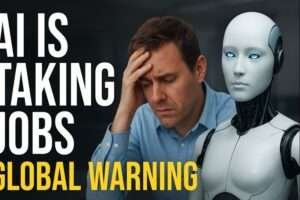
Job insecurity doesn’t just affect paychecks—it affects lives.
Studies show:
-
Rising anxiety among workers fearing replacement
-
Increased stress in gig and contract work
-
Declining job satisfaction in automated workplaces
If left unmanaged, A I-driven unemployment could fuel inequality, social unrest, and political instability across regions.
How Governments Are Responding
Countries are taking different approaches:
-
Investing in AI and digital education
-
Debating universal basic income (UBI)
-
Drafting AI regulations to protect workers
Still, many experts worry that technology is moving faster than policy, leaving workers exposed during the transition.
What Workers Can Do Today
Experts recommend focusing on skills that machines struggle to replace:
Future-Proof Skills:
-
Critical thinking
-
Creativity and problem-solving
-
Emotional intelligence
-
Leadership and communication
-
Advanced technical and AI literacy
In the AI era, lifelong learning is no longer optional—it’s essential.
The Future: Crisis or Opportunity?
AI itself is neither good nor bad—it is a tool. Whether it leads to prosperity or crisis depends on how it is used.
The coming decade will determine whether AI:
-
Builds a more productive and fair global economy
or -
Deepens inequality and displaces millions of workers
The decisions made today by governments, companies, and individuals will shape the future of work for generations.
Final Word
AI isn’t coming—it’s already here.
The real challenge is not stopping technology, but preparing humanity for change. With the right policies, education, and ethical choices, can become an opportunity rather than a disaster.
At Digital News Daily, we believe awareness is the first step toward resilience in an AI-driven world.